
posted by Dave Arnold
Low-Temperature and Sous-Vide Primer Contents:
- **Purdy Pictures: Sous-Vide and Low-Temp Charts** you are here
- I . Introduction to Low-Temperature Cooking and Sous-Vide
- II. Low-Temperature Cooking Without a Vacuum
- III. Use and Abuse of the Vacuum Machine andVacuum Tricks
- IV. Temperature Control and Safety
- V. Cooking Meats and Poultry
- VI. Cooking Fish
- VII. Cooking Everything Else
 Purdy Pictures: The Charts
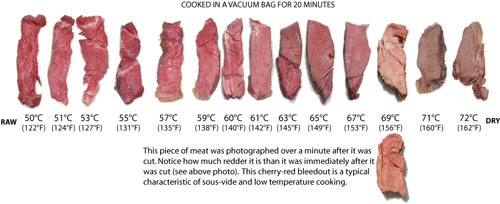
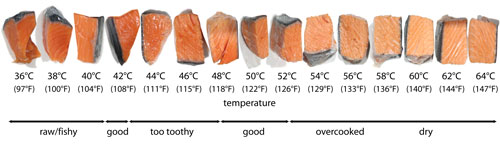
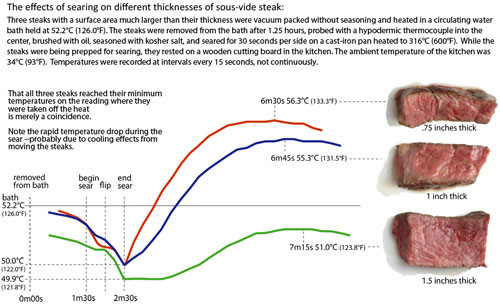
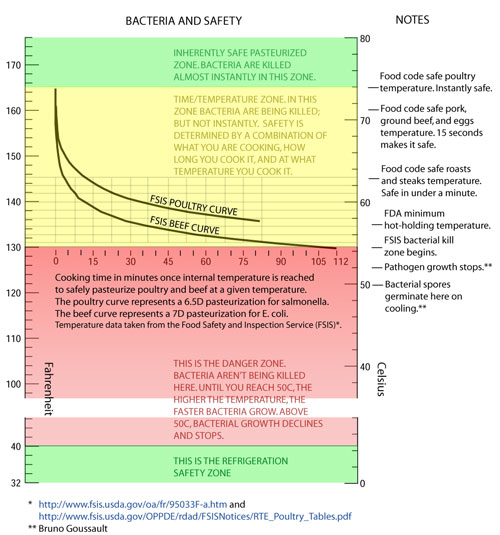
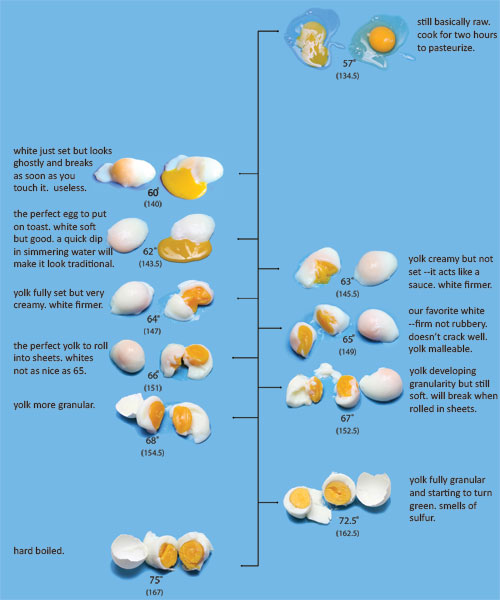
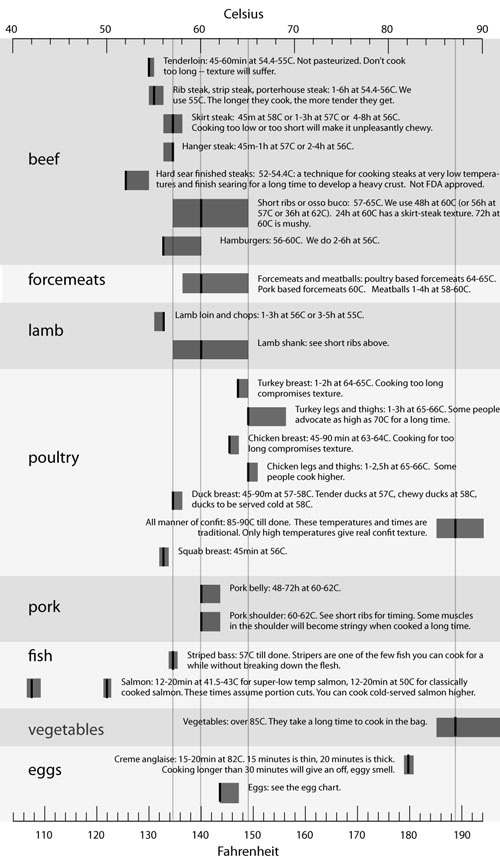
Here are some fancy charts we made for sous-vide and low-temperature cooking.
All of these images are available at higher resolution: here.

On to: Part I . Introduction to Low-Temperature Cooking and Sous-Vide
I have a question about the pork shoulder – what type of texture does 48h at 60C yield? Is it a tender steak, or like pulled pork? What happens to the fat – does it render at all at 60C? Thanks!
The fat won’t really render at 60C. Certain parts of the pork shoulder will be tender, but other parts might be a little fiber-y (although still tender). The problem with multi-muscle cuts like the shoulder is that some muscles respond differently to low temp-long time cooking. The muscles with a lot of connective tissue are great, but the ones with very little connective tissue tend to be better cooked for a shorter time.
Nice charts, does the hard sear finished steak method refer to the 45 second pre and 30 second post sear as shown in the picture or just simply post sear till as crusty as desired? Thanks
Howdy Hal,
The hard-sear technique is where you cook or retherm to a low temp –like 52 C and then give it a mega sear –like 2 minutes per side (sometimes more). The initial sear can be normal (around 45 secs per side, or longer)
Your blog is so helpful and endlessly fascinating!
Thanks so much for putting in the time and effort to educate the world with your gift of delicious.
I am truly inspired by your words and gorgeous charts!
My partner and I recently made our own sous-vide: http://qandabe.com/
and look to your site for guidance and inspiration daily.
Happy Thanksgiving!
Happy Thanksgiving
Any thoughts on cooking hen breasts? They are a traditional ingredient in several Venezuelan dishes, but traditional methods always result in a texture akin to hard rubber. I recently tried a 25mm-thick breast (boneless, skinless, unseared) at 66C for 25 minutes, with a three-step cooling process (15 minute spells at room temp and room temp water, followed by about 6o minutes in ice water), and the result was revelatory. Tender, juicy, full of natural flavor, and it looked to be fully cooked through. My biggest concern is safety, though. Was I endangering anyone?
Howdy Eduardo,
You should check this out: http://ddr.nal.usda.gov/bitstream/10113/29826/1/IND23218965.pdf
According to that study, the worst case scenario is that salmonella will start dying on the surface of the meat in a little over 2 minutes. After that, at only 65 C, 90 percent of the salmonella will die every 36 seconds (That is 1 D-level). Given a kill level of 10^6, at the surface, you are conservatively looking at a 6 minute cook time. There are far fewer bacteria at the center of the meat, but I don’t know how hot it will get in 25 minutes. Doug Baldwin and Nathan Myhrvold have those numbers, but I bet you get a couple of D-levels. I wouldn’t think you are going to hurt anyone but it wouldn’t be a bad idea to cook it a bit longer.
Dave,
Thanks for the info and the link. I got the cooking time/temp from Doug Baldwin’s charts and adapted them for the breast’s thickness. Although the data in the article gives me a bit of peace of mind, I’ll do some tests on longer cooking times vs. final results.
Hi,about big peaces of meat(as a english roaast-beef,2 kg each) low-temp cooking ,should I sear before or after?,I mean, with a combi-oven,20 min 170 C,and then meanwhile the core temperature increase I decrease the chamber temperature,and,apart the economic problems,the final results is it better with a combi-oven or with a CVap? (hope you can undestand me,my English must be orrible))thank’s
With very large pieces of meat I recommend using low temp “for insurance.” Take roast beef. Don’t bother searing. Cook the entire roast beef to rare (54.5 or 55 C, your choice). Cool the entire roast down. Now you have “insured” that the meat is cooked all the way to the center. Now put it in a blazing hot oven and develop a nice crust. This will give a roast beef that has some of the traditional texture of a roast beef (a little overdone on the outside) that most people like. Presenting a whole roast beef cooked to one temperature all the way through is usually unappetizing (believe me, I’ve tried).
Hi everybody,at the beginning of low-temperature cooking,is it better sear before or after the process? during cooking time the temperature must be increase or decrease?Usually,for a big pieces of meat(pork’s leg,5 kg)I follow this way:Combioven chamber 170C 20 min. and,meanwhile the core temp increase i decrease the chamber temp.(row pork core temp.4 C to 70C-chamber temp.170 C to 70 C)what do you think?
Howdy Lele,
I usually sear both before and after because being in the bag ruins the crust. If you don’t have that problem in the combi you can do as you say, but most people hit meat with some low humidity/high temprature stuff at the end to spruce up the crust.
Dear Sir or Madam,
I have worked through the pages, relevant to sous-vide cooking. As I understood, tine-temp. chart is intended for cook-and-serve service. Do you have some simmular chart for cook-and-chill(store) cooking sous-vide? I do quite a big stakes of beef in our restaurant. I am not happy with 40 min. cooking time traditionally. We made a trial to cook it sous-vide. The result is excellent. But how long can i store this meet?
we hold QT 55C for rare at least 121 min, QT 60C for medium for at least 90 min. Then chill it down and in 60 min it has from -2 to +1 in the core. How long can i store these stakes? these is just one of examples. I really need additional information for cook sous-vide-chill-store-regenerate technique. I was not able to find such information on FSIS site, as well as on HACCP sites. I would appreciate any help. Thank you in advance.
How long you are allowed to hold the steaks depends on 2 factors 1. How many D levels you have cooked the product to (that you can get from the FSIS site). 2. How cold your storage is. WE are currently getting well over a week storage if your temps are below 34 F and you have done 6 or so D levels of Bacterial death. UNfortunately I don’t think the steaks are necessarily at their best at that point. Don’t quote me on the exact numbers — the ones I just quoted are off the top of my head (I’m writing in an airport)